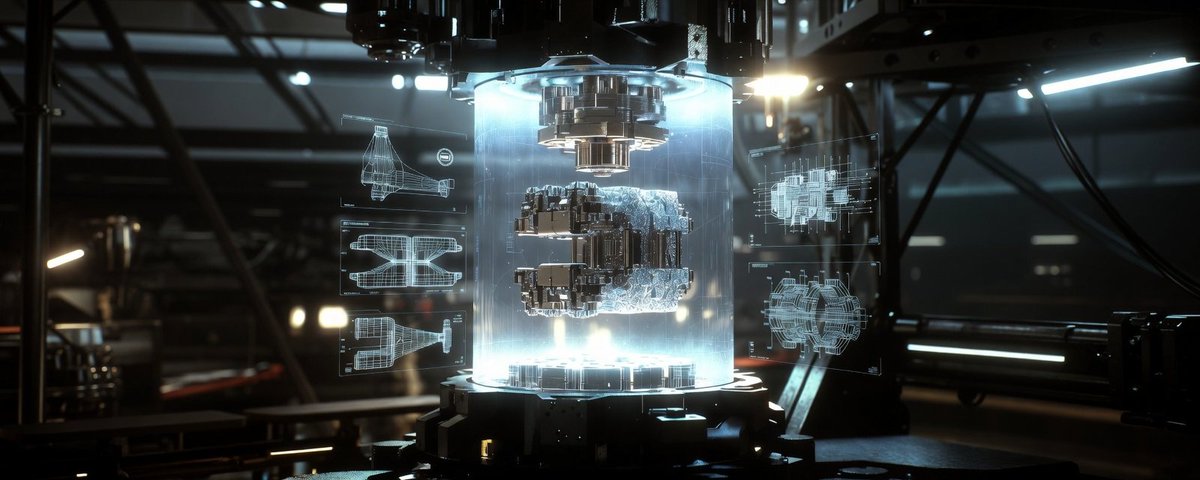
“Compliant Mechanism” is the worst possible marketing for one of the best ideas in modern engineering.
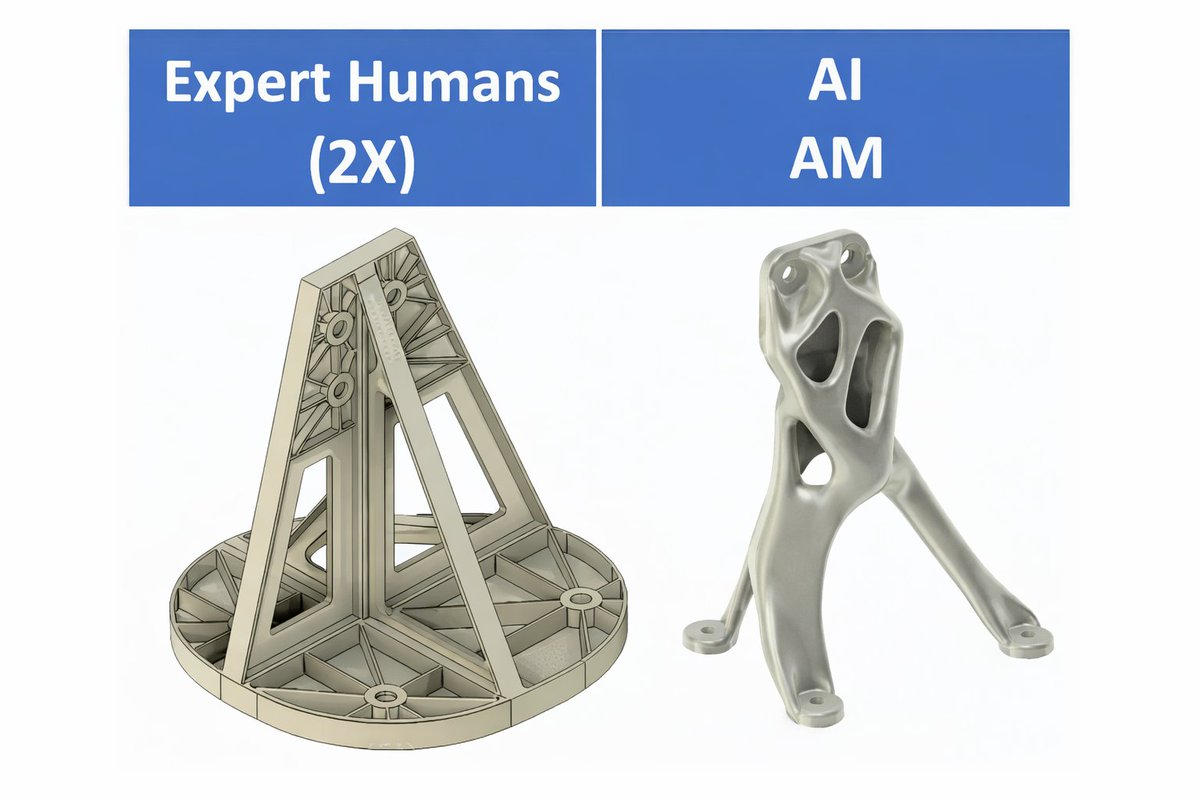
The piece on the right weighs 93% less than the piece on the left. Yet they have the same function, strength, stiffness, and exact same performance. It was designed by AI for a real NASA space mission by Ryan McClelland, a Research Engineer there. He’s now done this for 36+ real applications, from telescopes to Venus landers.
From 2023 to 2024, McClelland had an intern. That intern redesigned an optical lens bracket using AI, collapsing a multi-part assembly into a single monolithic piece. Fewer parts, fewer failure points, simpler manufacturing, better performance. It also happened to drop the weight from 600 grams to 40 grams – a 15x reduction (this matters even more when you’re building robots, but we’ll get there).
That intern also has a name – Ethan Wicko. You should know Ethan. He just started a company called Transcend Mechanics, and I just watched him pitch at Discipulus Ventures Demo Day. I’d spent the days leading up to it researching what he’s building and why it matters.
This is what I’ve got so far.
Compliant Mechanisms
A compliant mechanism is a single piece of material shaped to bend in a specific, controlled way to do the job that would normally require multiple rigid parts bolted together. One piece instead of five. No hinges, springs, bearings, or fasteners.
But assembling a compliant mechanism isn’t just 3D printing a shape. What goes into the design of a compliant mechanism is physics, materials science, geometry, and a deep understanding of how the manufacturing process constrains what shapes you can actually produce.
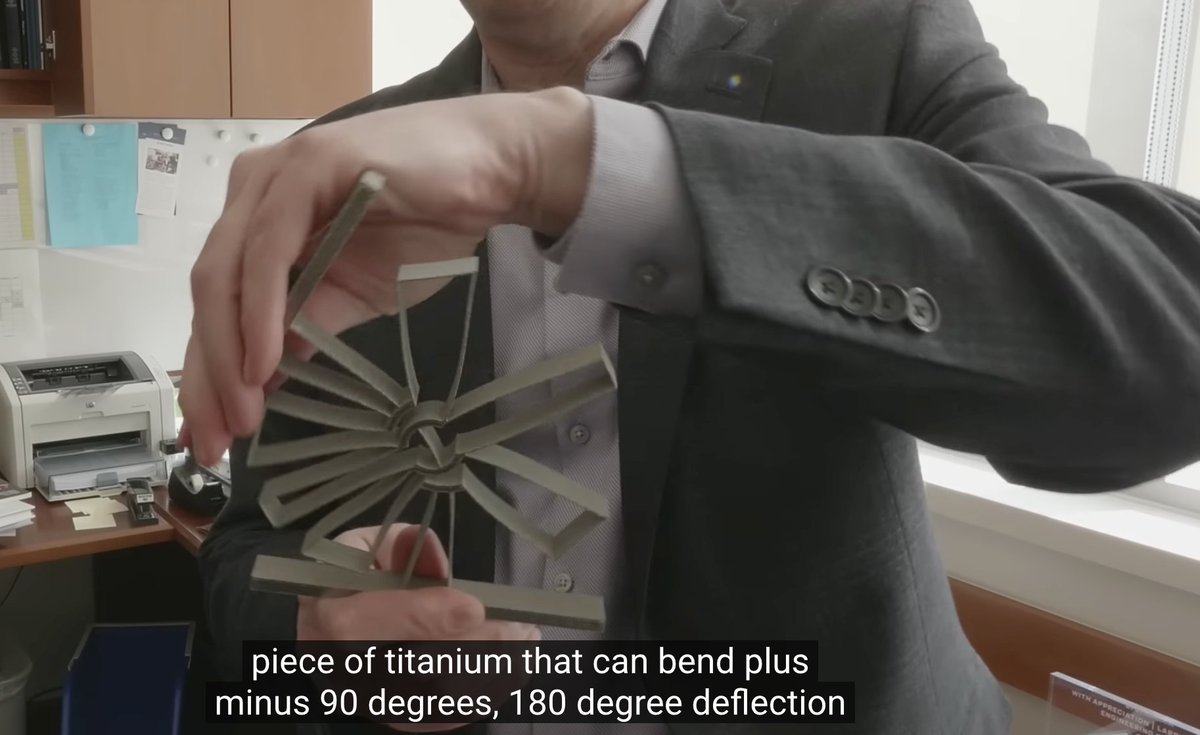
A solid piece of titanium that can bend 180 degrees, with no bearings, joints, or pins, is one of the cleaner examples. One such piece is made to deploy solar panels on satellites. It’s replacing several parts that were bolted together. When you’re deploying hardware, parts can corrode or wear out. A single failed bearing or corroded bolt becomes a single point of failure in hardware that costs hundreds of millions to build and launch. The compliant mechanism eliminates that risk entirely – it will always function as designed, with no corrosion, stiffness, or error. It saves you margin in places you absolutely cannot afford to lose it.
Now scale this down to the chip level. Your phone is filled with compliant mechanisms – the accelerometer that knows when you rotate the screen, the gyroscope, the microphone. At the microscopic level, you can’t assemble separate parts, so the only option is to etch a single piece that flexes.
Compliant mechanisms are in your phone, every satellite, nuclear weapons safety systems, medical devices, and in pretty much every critical device you use. Yet nobody outside of mechanical engineering is talking about them, because the phrase “compliant mechanism” is the worst possible marketing for one of the best ideas in modern engineering.
They’re also better than traditional assemblies in a few ways. One piece is cheaper than five. No joints to wear out, no screws to loosen, no corrosion between parts. They move the same way every time. They can sit in a nuclear silo for 30 years and work on the first try.
So why isn’t everything a compliant mechanism?
The Design Problem
Because designing them is brutally hard.
When you bend a material, the forces inside it follow rules from physics and math that are genuinely complex. How the stress spreads through the shape, whether it’ll snap after a thousand bends or a million, whether the material will spring back to its original shape or permanently deform. This is all governed by equations that take massive compute power to solve.
For a compliant mechanism to work, the geometry has to deform the exact way you want, the stress on it has to stay below the threshold where it actually breaks, and the whole shape has to be something you can realistically manufacture. Injection molding has different rules than 3D printing, which has different rules than a CNC machine, which has different rules than photolithography. The physics and manufacturing constraints have to be satisfied simultaneously, and small changes in geometry can completely change how the part behaves.
A good mechanical engineer might spend six months designing one compliant mechanism. Then teams of PhDs run simulations, adjusting the shape and running it again. Weeks per iteration.
All this is to say, if you need a custom compliant mechanism (say a specific gripper for your robot or an actuator for your satellite), you…
- Go to a vendor’s website…
- Click that horrible “request a quote” button…
- Wait… and wait… and wait…
- Then, after weeks of emails, rounds of specification, quote negotiations, and long production lead times…
- The part shows up months later.
That’s why Transcend is building what they call the “Matter Compiler.” Just tell them what you need, and have it back in your own hands before the “Request a Quote” people even email you back.

Why This Matters for Robotics Right Now
Humanoid robots are scaling. Figure, 1X, Unitree, Boston Dynamics, Agility Robotics – all of them are transitioning from prototype to production. Each one of them needs custom compliant hardware at nearly every joint and interaction point.
Think about a robot hand. Each finger needs to grip an egg without cracking it and a wrench without dropping it. Both of these actions have severely different force profiles, but “gripping” is the same mechanism. The traditional approach is to design separate gripper assemblies with individual springs, bearings, force sensors, and structural parts. Each one is a custom engineering project with its own simulation cycles, its own “request a quote” nightmare, its own three-month lead time.
How can a compliant mechanism help here? A single-piece compliant gripper can replace an entire assembly of rigid parts. No bearings to wear out from repeated gripping. No lubricant to contaminate whatever the robot is handling. No “backlash” or “slop”, as engineers say. The gripper is lighter, so the motors work less strenuously. It helps prevent wear-and-tear on the robots, but also helps them function more precisely.
But someone actually has to design that gripper. And one for the elbow actuator. And the ankle flexure. And the sensory mounts, and the wrist. Multiply that across every joint on a humanoid robot, across every company building one, and you start to see the bottleneck. There aren’t enough mechanical engineers on Earth who know how to do this work, and even the ones who do take months per part.
This is where Transcend comes in.
Transcend’s Demo Day Pitch
Ethan Wicko lived the “request a quote” pain at SpaceX, where he was a fluid systems engineer on the Starship team at Boca Chica. When the company you work for is trying to get to Mars and you’re still waiting six weeks for a bracket, you start to feel like the supply chain itself is the bottleneck.
Ethan says that the bottleneck isn’t manufacturing. We have accessible 3D printers, CNC mills, photolithography. The bottleneck is design – the multi-physics optimization work that takes a team of specialists months to do by hand.
Transcend is the AI that replaces that bottleneck.
You tell them what you need: the function, the constraints, the material, the manufacturing method. Their multi-physics engine combines generative AI (diffusion models trained on mechanical geometry) with physics simulators (finite element analysis for stress, strain, fatigue, thermal behavior) to generate candidate designs, score them against your constraints, and iterate toward the best solution using reinforcement learning. Out the other end comes a manufacturing-ready design. Transcend delivers the part.
This engine is a more advanced version of what Ethan built at NASA. It’s the same approach that allowed him to turn a 600g bracket into a 40g bracket. He watched it work at NASA, and now he’s commercializing it through Transcend.
His co-founder, Alexander McLeod, comes from nuclear engineering, where he worked on applying AI to improve engineering workflows in the nuclear world. Nuclear is one of the most reliability-obsessed industries on Earth, which makes the transition to compliant mechanisms a no-brainer.
Why Now
The AI got good enough about 18 months ago. Diffusion models (the same architecture behind AI image generators) turn out to also work for generating 3D mechanical geometry, if you train them on mechanical parts and couple them to a physics engine.
The customers showed up at the same time. Defense is reshoring manufacturing. The CHIPS and Science Act is pumping $280 billion into domestic hardware. Robotics companies are scaling and need custom compliant hardware at every joint. And every one of these customers currently gets their parts through the “request a quote” cycle.
The talent to build this barely exists. You need someone who understands SpaceX-grade hardware, NASA-grade generative design, modern ML, numerical methods, and real manufacturing constraints. That Venn diagram has maybe two dozen people in it globally.
Transcend signed their first defense contract before Demo Day. The roadmap from here: sensors and grippers now, actuators in three months, working toward a full robot.
Hadrian
Anyone in defense tech will immediately compare this to Hadrian, which has raised over $600M to date from Lux Capital, a16z, and Founders Fund. Same macro thesis: AI-automated precision manufacturing, defense customers, reshoring tailwind.
But Hadrian is a manufacturing company that uses AI to run its factory. Transcend is a design company that uses AI to generate the thing that gets manufactured, and then delivers it. Hadrian makes existing parts faster. Transcend makes parts that didn’t exist yet.
Different layers of the same stack. In the world both are betting on, Transcend generates the part and Hadrian machines it.
Why I’m Writing This
I wrote an essay a couple weeks ago called “Reshoring, Reindustrialization, and Compounding Data Advantage.” Thank you to the five people who read it lol.
The argument is that data flywheels that don’t feed into physical infrastructure eventually get commoditized. The hardware is the anchor.
Transcend Mechanics lives that thesis.
Every design the engine produces trains the model. Every manufactured part validates the physics. Every customer relationship generates data that makes the next design faster and better. The flywheel compounds back into itself, and what comes out on the other end is sensors, actuators, and eventually robots.
Transcend Mechanics is a Spring 2026 Discipulus Ventures cohort company. If you’re building something physical, or investing in people who are, you should speak with Ethan. You can email him directly at ethan@transcendmechanics.com or DM me for an intro.
Sources
- Personal chats with both Ethan and Alex from Transcend Mechanics
- NASA Evolved Structures: nasa.gov/technology/goddard-tech/nasa-turns-to-ai-to-design-mission-hardware
- Ryan McClelland Keynote: youtube.com/watch?v=t_h_WmBhRXA
- Veritasium – Why Machines That Bend Are Better:
- BYU Compliant Mechanisms Research: compliantmechanisms.byu.edu
- Discipulus Ventures: discipulusventures.com
- My prior essay: The Factory is the Moat