AI-enabled PE-style roll-ups are here. The flywheel: buy legacy services firms → gut the overhead → inject AI bones → improve margins → use the free cash flow to acquire the next one. Rinse and repeat. Euclid Ventures wrote about it in 2024 and has since deployed accordingly. General Catalyst did the same. Elad Gil called it as well.
By now, anyone with some business acumen and a Claude/Codex subscription has had an idea along these lines. There’s undoubtedly massive upside for many in the roll-up model, but in each idea I explore, I keep hitting the same wall.
Moats are eroding across the application layer of software. Many of the AI-enabled vertical apps and tech-enabled services everyone is rushing to build right now are headed for a margin-race to zero. LLMs gave everyone the same baseline. From there, it’s a race to improve your model with proprietary data. But if everyone can achieve nearly the same end result, you’re fighting on margin. The “compounding data advantage” one can build today erodes dramatically over time as everyone reaches the same endpoint, just with different data.
To give you an example, I’d been fleshing out an idea for a real estate finance platform. It speeds up the loan underwriting process (I know…you’ve already heard about dozens of these). A deal today takes 3 weeks to get pushed through by humans, from loan request (borrower) to funded loan (loan processor). AI reduces the decision making and analysis to, theoretically, a same-day turnaround (and theoretically same-day loan funding). Now your $1B backlog of unserviced loans can become serviced.
BUT, if you zoom out, the playing field is level. Everyone has their own compounding data advantage flywheel, but the same result: loans are processed faster, with a higher degree of accuracy and lower risk. Now we all compete on fees. Typical loan processors take 2-3% of each deal, plus servicing fees. If everyone has the same output, ultimately borrowers will go to whoever has the lowest take rate. This game almost becomes zero-sum for the service provider.
Compounding data advantage alone isn’t a moat. It’s a race to zero.
Tesla
Tesla is a data company that makes cars. And for me, Tesla was the company that solidified the whole concept of compounding data advantage as a moat.
Tesla’s flywheel: Lower the cost-curve of manufacturing → cheaper cars → more cars on the road → more real-world data → better Full Self Driving → cars get more valuable → sell more cars → repeat.
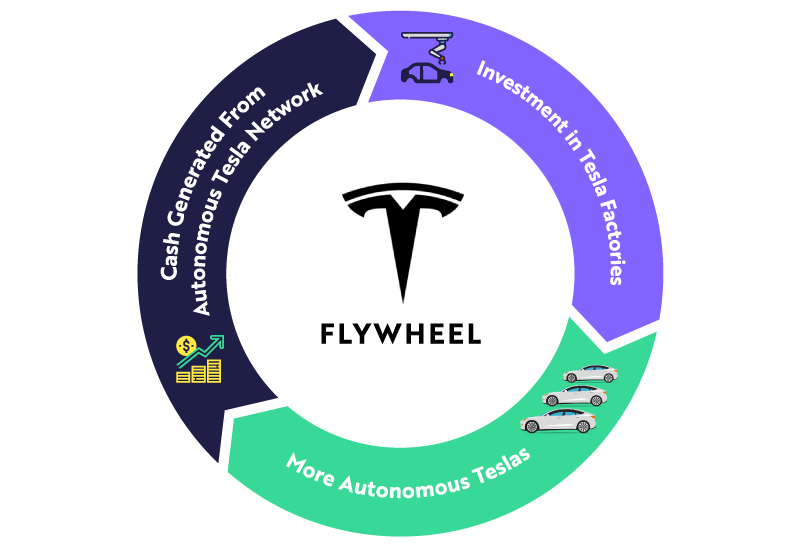
Tesla collects video feeds, steering and braking inputs, edge cases (weird intersections, construction zones, etc.), and most importantly, FSD disengagements. Every time a human grabs the wheel back from FSD is a labeled training example (“here’s where the model was wrong”). That’s the gold.
This is the same flywheel that every AI roll-up is trying to recreate. Acquire firms, inherit their data, compound the advantage. Same logic, different industry. But here’s what they’re missing.
Tesla’s data flywheel works because the data is bolted to something no one can replicate: the factories. The Gigafactories. Manufacturing automation. The vertically integrated supply chain. The endless regulatory fights it takes to sell cars in America. You can’t acquire your way into any of that.
The data isn’t a moat when the output is commoditized. The moat is physical. Tesla’s data compounds into the factory. This is the part everyone copying the flywheel is missing. Data that compounds into something physical and irreplaceable is a moat.
Lessons Learned from HEAT
In 2021 I took a bet that human motion data was vital but overlooked. Our long-term vision was to sell human motion data to robotics companies. We collected full-body 3D mocap using XSens suits. They were studio-grade and we’d spend hours manually polishing each movement post-capture to be perfect animations. The thesis was that this data would be essential for training the next generation of generative animation models, and eventually humanoid robots.
I was right about the thesis but wrong about the timing.
Robotics firms weren’t buying yet, so we tried to monetize via animators – game devs, animation studios, indie animation hobbyists. Generative animation moved faster than we expected. Synthetic data got good enough. Labs started scraping 2D video and lifting it into 3D. The premium we charged for studio-quality mocap started looking less premium when “good enough” was free and infinite. We saw the race to zero coming and pivoted, partnering with Universal Music Group to license artists’ emotes for games. “Premium IP” as the moat instead of “premium data”.
It didn’t save us. I wound down HEAT in December of 2025.
The space has since evolved into both teleoperation and egocentric data (first-person capture from wearables, the actual hand-eye view robotics companies need for manipulation models). The economics look great for now. But the underlying dynamic is the same one I watched play out in mocap. The winners won’t be the ones who create the data, they’ll be the ones who use it to build something physical.
It’s the same lesson: data flywheels only work if the data compounds into something that can’t be replicated. If your data is the product, you’re one synthetic dataset away from irrelevance. If your data makes a physical thing better – a robot more capable, a factory more efficient, a supply chain more resilient – now you have something worth defending.
The Factory is the Moat
Here’s where I’ve landed.
Not all factories are moats. Most aren’t, actually. Foxconn runs some of the most sophisticated manufacturing on earth and earns 2-3% net margins. Solyndra had a $535M factory and flopped. If the output and process are replicable, the factory is a cost center and not a moat.
The factories that are moats fall into three categories:
1. Process knowledge moats. TSMC doesn’t win because it has fabs. Samsung and Intel also have fabs. TSMC wins because their process engineering is years ahead of anyone else, and there are maybe a few hundred people on earth who understand EUV lithography at that level. The IP is in the process, and it took decades of iteration to get there. You can’t catch up in 18 months.
2. Integrated Systems Moats. This is Tesla. The Gigapress isn’t defensible because it’s a big machine. Anyone can buy one. It’s defensible because the entire vehicle architecture was redesigned around it. The process is tightly coupled across design, materials, software, and production. You can’t pull one piece out of Tesla’s factory and copy it. The Cybercab is the clearest recent example.
3. Commodity Traps. Garment manufacturing and standard contract manufacturing. As currently practiced, these are races to the bottom with extra steps. The whole reason they got offshored in the first place was that labor cost was the dominant variable, and US labor couldn’t compete. But automation is starting to flip that equation. If a robot can stitch a shirt for the same unit cost in LA as a human can in Bangladesh, the “trap” stops being a trap.
You win when proprietary process knowledge compounds inside something physical. The factory is the container but the process knowledge inside it is the moat. You can’t have one without the other and that’s what makes it defensible.
This is what makes Tesla and TSMC outliers. The next decade of American manufacturing will be built by people who can hack it next.
Why Now
We (the US) perfected the factory model. From Ford’s assembly line to textile mills, steel towns, and auto plants that built our middle class, the US had nearly 150 years of being the best in the world at making physical goods. Then, over about 40 years, we closed most of our factories and shipped the model overseas. China took it, advanced it, and it spread across Southeast Asia, anywhere with cheap labor and poor regulatory oversight. We optimized for cheap goods on our shelves and called it free trade. What we actually did was offshore the knowledge, the workforce, and the strategic capacity to make the things our economy depends on.
Reshoring today and going forward
We must bring factories back, but we must also acknowledge that our old model won’t work. Factory margins are thin to begin with, and you’re not going to replace a $4/hr factory line worker with a $40/hr worker and stay competitive. What does work is using automation and process knowledge to make American factories cost-competitive while creating higher-skilled jobs around them. Once factories are sufficiently automated, the next margin-frontier is supply chain optimization, which is where the following decade of efficiency gains comes from.
With regard to AI, many people are worried about job automation leading to a reduction in workforce. We’re already seeing tons of layoffs across big tech, and those are jobs that are likely not coming back.
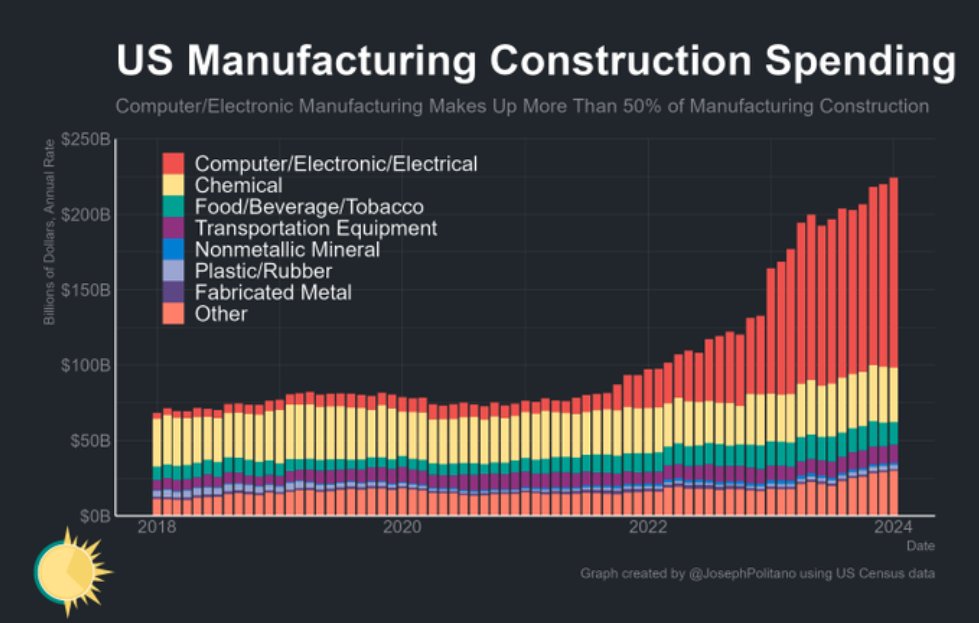
In the factory setting, however, the “automation kills jobs” reflex misses what’s really going on. Tesla employs 140,000 people. Eli Lilly is investing $27B in US pharma manufacturing, which will create 13,000 jobs. According to the Reshoring Initiative, 244,000 manufacturing jobs were announced in 2024 via reshoring and foreign direct investment, and over 2 million jobs have been announced cumulatively since 2010. Advanced manufacturing brings jobs back, but is also changing what the jobs are; jobs that are higher-skilled, higher-paid, and harder to offshore.
Three Converging Forces
1. Tariffs. Importing has become insanely expensive across the board. Whether you agree with the policies or not, the math is no longer mathing for cheaply importing the things we’re used to importing.
2. Logistics fragility. Covid messed up trade routes. Port backlogs, the Suez Canal. Now the Strait of Hormuz. The “supply chain” has become a web of single points of failure stretched across the oceans.
3. Geopolitical risk and self-reliance. We’ve isolated ourselves whether we like it or not. Even under an administrative change, the world has woken up to the fact that economic interdependence is leverage. Countries are all building, or at least now thinking about, domestic capacity because they’ve seen what happens when they don’t have it. Ourselves included. I don’t think this genie goes back in its bottle.
This isn’t partisan.
While the left and the right live in seemingly alternate realities, our underlying reality is the same. You live here. You should want it to be good. And making it good, given the circumstances, means bringing this stuff back onto US soil. Building it here, employing people here.
Reshoring creates jobs. Whether you’re on the left, the right, or somewhere in between, it’s in your interest as an American for us to reshore and reindustrialize.
The Next Frontier Has Already Begun
Hadrian is the golden child embodiment of everything we’ve discussed so far.
Founded in 2020, Hadrian builds AI-powered, highly automated factories that produce components for aerospace and defense. They work directly with SpaceX, Rocket Lab, and Lockheed Martin to make parts that go into rockets, satellites, jets, and drones. They’ve expanded to three facilities and are hiring for 145 positions right now.
This is the “integrated systems moat” in real life. They’ve got proprietary software (Opus) running the floor, automated quality inspection, tool path optimization, adaptive programming…and they’ve started embedding “factory-as-a-service” cells inside Lockheed’s facilities. This is Tesla’s playbook applied to defense!
Shaun Maguire put it well: “every software revolution is preceded by a hardware revolution.” Hadrian’s and Tesla’s playbook will be extrapolated to countless other industries in our current and forward-looking reshoring efforts. Bezos is already a leader in automated logistics via Amazon, but he’s also reportedly raising $100B to buy and revamp manufacturing firms with AI. The SBA just announced 0% upfront fees for 7(a) manufacturing loans up to $950k. And on the start-up and innovation front, Jakob Diepenbrock and Discipulus Ventures are running a fund and residency in El Segundo backing hardware founders at the earliest stage who are working on the country’s hardest physical problems.
From defense to aerospace to textiles, it’s already happening. We’re still in the early innings, and I have the utmost respect for those taking the biggest swings right now.
How do I fit in?
I want to be extremely up-front. I am an outsider. I’m not a manufacturing expert, nor have I ever run a factory floor. My career has spanned media and entertainment (sales and distribution at a major film studio), to being an early employee of a fast-growing legal services business (exited), to starting my own tech business backed by A16Z and Samsung (flopped).
What I am is hungry, passionate, and voraciously curious. I’ve been enmeshed in the tech scene for a number of years now, and what’s really not interesting to me at this point are pitches about tax software that helps SaaS companies churn slightly less. I’ve taken my sabbatical to think long and hard about where the world is going, and the answer I keep arriving at is that the most important problems of the next century, for the sake of civilization, are physical. The thread that connects them is energy - physical, human, and computational energy. Specifically how we generate it, store it, and what we choose to spend it on.
A few weeks ago I went to a bonfire in El Segundo. I met people building automated welding facilities, people building nuclear power plants, and the people leasing them the land. People who had spent their careers in aerospace, defense, and manufacturing, and who are now starting companies because they can feel the window opening. These people aren’t larping for clout and a “Founder” title. These are real builders who have been overlooked for too long but now will have their chance to shine.
So today I spend my time meeting founders. I’m writing small angel checks where I can (and expanding my network to syndicate out high-quality deals to bigger check-writers who want exposure). I’m doing as many factory tours, site visits, and meetings as possible, trying to sponge up as much information as I can from people who know more than I do, and trying to be useful in the small ways I can be (intros, capital, second opinions, deck review / pitch practice). I don’t have the answers, I simply just want to be involved in what’s important.
If you’re building in this space, or investing in it (or seriously thinking about it), I want to hear from you. I’d love your feedback, pushback, and to learn what you’re passionately building toward.